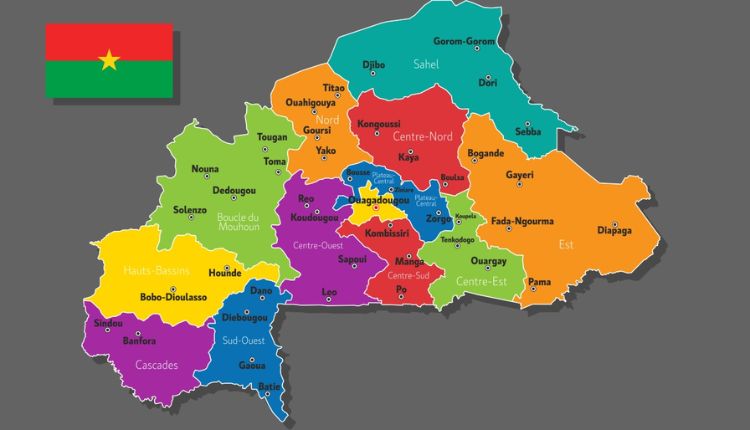
It reflects the history, culture, administrative organization, natural resources and strategic location on the African continent. Whether you are a student, traveller, researcher or business investor, understanding the map of Burkina Faso offers valuable insights into the country’s structure and identity.
Burkina Faso is a landlocked country in West Africa, bordered by six countries and known for its diverse landscape, rich cultural traditions and growing economic potential. A detailed exploration of the carte du Burkina Faso helps to reveal its provinces, regions, major cities, rivers and transport networks.
Below is a comprehensive guide to SEO that is structured into eight focused subheadings, each exploring a major aspect of the country map.
Geographic overview
The carte du burkina faso shows the landlocked country located in West Africa. It borders Mali to the north and west, Niger to the east, Benin to the southeast, Togo and Ghana to the south, and the Ivory Coast to the southwest. Its central location in West Africa makes it geographically important for trade and regional cooperation.
The country covers an area of approximately 274,200 square kilometres, making it a medium-sized nation in Africa. The terrain is mostly flat to gently rolling plains, with some hills in the western and southeastern areas. Unlike many African countries, Burkina Faso does not have access to the sea, which greatly affects its trade routes and economic strategies.
On the map, the country looks somewhat rectangular in shape. Its location in the Sahel region influences climate patterns, with the northern regions being more arid and the southern more fertile. Understanding the carte du Burkina Faso allows observers to understand the diversity of the country’s environment and how geography affects daily life.
Climatic zones are also visible when analysing Carte du Burkina Faso thematic maps. The north experiences a semi-arid climate, while the south benefits from more rainfall. These geographic variations are necessary for agriculture, settlement, and economic activities.
Administrative regions
The administrative map, or carte administratif du Burkina Faso, divides the country into 13 regions. These regions are further divided into provinces and departments. Each region plays a vital role in governance and development.
The 13 regions include:
- Boucle du Mouhoun
- Cascades
- Center
- Centre-East
- Center-Nord
- Centre-Ouest
- Center-Sud
- Estimate
- Hauts-Bassins
- Nord
- Plateau-Central
- Sahel
- Sud-Ouest
Each region has its own capital and administrative structure. For example, the Center region includes the state capital of Ouagadougou, which serves as the political and economic heart of the country.
An administrative map helps citizens understand local systems of government. It also helps in planning development projects, expanding infrastructure and public services. Regional boundaries are clearly marked, making it easy to identify areas of jurisdiction.
These divisions were designed to improve administrative efficiency and promote balanced national development. By studying the carte du Burkina Faso, it is possible to see how the administrative organization is in accordance with geographical and demographic factors.
Big cities
A detailed carte du Burkina Faso shows the main cities of the country that serve as economic and cultural centres. The largest city is Ouagadougou, located in the central part of the country. It is the administrative capital and hosts government institutions, universities and international organisations.
Another key town is Bobo-Dioulasso, located in the Hauts-Bassins region. It is known as the economic capital and is an important center of trade, agriculture and culture.
Other notable cities include:
- Koudouga
- Ouahigouya
- Banff
- Fado N’Gourma
- Kaya
These cities are strategically located in different regions, ensuring national connectivity. On the map, major urban centres are usually marked with larger symbols to indicate population size and importance.
Urban areas are typically located near water sources or fertile land, which has historically influenced settlement patterns. Today, these cities are connected by a transport infrastructure that supports trade and mobility.
Studying the city layout on the Carte du Burkina Faso helps to understand economic nodes, population density, and regional influence.
Rivers and water bodies
Although Burkina Faso is landlocked, its map reveals several important rivers and bodies of water that support agriculture and human settlement. The most important river system is the Volta river basin.
Three main branches of the Volta River flow through the country:
- Black Volta
- White Volta
- Red Volta
These rivers are essential for irrigation, fishing and hydropower. They also contribute to cross-border water management cooperation with neighbouring countries.
Seasonal rivers and small lakes appear on the map, especially in the southern and western regions. During the rainy season, these water resources expand and support farming communities.
The availability of water strongly affects agricultural production. Southern regions benefit from more consistent rainfall and river systems, while northern regions face problems due to lower rainfall.
Hydrological maps of Burkina Faso show how water resources are distributed throughout the territory. These maps are crucial for irrigation project planning and climate risk management.
The Carte du Burkina Faso therefore provides not only geographical outlines but also a view of the distribution of natural resources.
Climatic zones
Burkina Faso’s climate map divides the country into three primary zones: Sahelian, Sudano-Sahelian, and Sudanian. These zones are clearly visible when analyzing environmental maps.
The northern part belongs to the Sahelian zone, which is characterised by low precipitation and high temperatures. Vegetation is sparse, and desertification presents environmental challenges.
The central region falls under the Sudano-Sahelian zone, where rainfall is moderate. This region supports mixed farming and livestock farming.
The southern region belongs to the Sudanese zone, where rainfall is higher and vegetation is more abundant. Agricultural activity is more productive in this area.
The climate directly affects:
- Agricultural productivity
- Population density
- Economic activities
- Environmental sustainability
Rainfall is seasonal, with a dry season and a wet season. The rainy season usually occurs between May and October.
Understanding climate distribution through the Carte du Burkina Faso helps policymakers and researchers address food security and environmental planning.
Transport network
Burkina Faso’s transport map reveals a network of roads and railways connecting major cities and neighbouring countries. Major highways connect Ouagadougou with Bobo-Dioulasso and stretch towards the Ivory Coast and Ghana. These trade corridors allow goods to reach seaports in neighbouring countries.
Railway lines mainly connect Ouagadougou with Abidjan in the Ivory Coast. This railway is crucial for the import and export of goods.
The main transport features include:
- National highway
- Regional road
- Rail connection
- International trade routes
Air transport is also important. Ouagadougou International Airport serves as the main gateway for international travel.
The Carte du Burkina Faso shows how transport infrastructure is concentrated in the central and southern regions, reflecting patterns of economic activity.
Infrastructure development remains a national priority, as better connectivity supports economic growth.
Natural resources
Burkina Faso resource maps highlight mineral deposits and agricultural areas. The country is known for its gold production, which plays a major role in its economy.
Mining areas are located mainly in the western and northern regions. Gold exports contribute significantly to national income.
Other natural resources include:
- Manganese
- Limestone
- Marble
- Phosphate
Agricultural land is widely distributed in the Carte du Burkina Faso central and southern regions. Cotton is the main export crop, along with corn and sorghum.
Forestry resources are concentrated in the southern zones, while cattle ranching is common in the northern areas.
Carte du Burkina Faso helps investors identify resource-rich regions and understand economic geography.
Cultural and strategic importance
The map of Burkina Faso also reflects cultural diversity and strategic importance. The country is home to many ethnic groups, including the Mossi, Fulani and Bobo communities.
Cultural festivals and historical monuments are spread across different regions. For example, Ouagadougou hosts major film festivals and cultural events.
Strategically, Burkina Faso’s central location in West Africa makes it an important regional partner. It participates in economic and security cooperation initiatives within the region.
Border regions are particularly important for trade and migration. The map shows how Burkina Faso is connected to neighbouring nations.