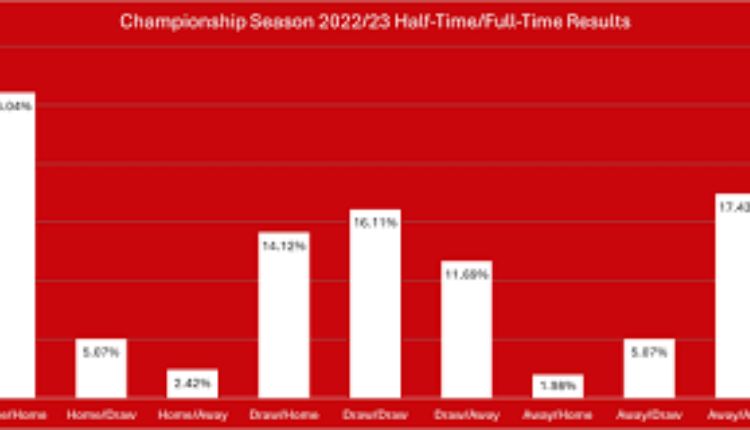
Timing often determines success in football betting as much as team quality does. The 2022/2023 season revealed how reading matches through first-half and second-half statistical divides enhanced both pre-match and live betting precision. Teams displayed repeatable patterns—slow starters turning lethal later, or dominant openers fading under fatigue—which transformed betting from intuition into pattern recognition.
Why Splitting Performance by Halves Clarifies Value
Aggregated season statistics conceal variance. Isolating team performance by the first and second half exposes rhythm, managerial intent, and situational psychology. For example, clubs with defensive conservatism early but attack persistence late generated distinct value in live “over” bets after halftime. Viewing matches in split phases provided bettors a way to intercept market corrections before odds adjusted.
Key Statistical Insights from 2022/2023
Across Europe’s top leagues, certain trends repeated within match segments, revealing tactical behavior more than luck.
| Type | Characteristic | Impact on Betting |
| High first-half tempo | Fast press, early shot volume, fatigue later | Advantage: early over markets, halftime unders |
| Low first-half xG, rising second-half xG | Gradual build-up with reactive play | Strength in live over timing after 55th minute |
| Defensive starts, late concession | Focus on control until substitutions | Unders early, then goal-line shifts create opportunity |
| Late-game efficiency | Higher shot conversion beyond 70 mins | Profitable for live over/BTTS bettors |
Interpreting these shifts allowed bettors to pivot mid-match rather than cling to pre-game assumptions.
Teams with Consistent Timing Bias
During the 2022/2023 season, timing tendencies divided clubs into tactical archetypes:
- First-half dominators: Manchester City, Lazio, PSG. They often closed matches early, ideal for halftime leads or first-half overs.
- Second-half reactors: Liverpool, Atalanta, Villarreal. They relied on intensity build-up, producing later scoring bursts.
- Control managers: Real Sociedad, Lens, Juventus. Low-variance teams whose halves mirrored one another, favoring unders and draws across intervals.
Once the trend stabilized statistically after ten games, late-season data delivered strategic reliability for bettors targeting live swings after halftime.
Tactical Interpretation Behind Each Half
A team’s half-by-half output reflects managerial intent and player endurance rather than randomness.
- First-half dominance often results from scripted attack plans and energy spikes from pressing lines.
- Second-half surges reflect patient tactics premised on exploiting fatigue in opponents or tactical reshuffles.
Recognizing which mechanism drives output is vital; betting value lies not in abstract timing but in identifying reproducible triggers.
Reading Match Flow with UFABET Analytical Tools
During fast-moving fixtures where tempo reversal defined profitability, bettors applied live data tracking from analytical environments including ufa168. The system’s integrated metrics—pressure heatmaps, halftime xG differentials, and substitution trends—helped identify when the next goal probability spiked beyond the model baseline. Instead of guessing, users correlated real-time rhythm change with market delay. This alignment of visual and statistical input reduced emotional decisions, turning momentum into quantitative forecast precision.
Influence of Substitutions and Managerial Adaptation
Substitutions prove decisive in half-by-half analysis. Attack-minded changes after 60 minutes modified tempo curves by raising chance volume quickly. Identifying managers with aggressive bench patterns (e.g., Klopp, Gasperini, or Arteta) offered an edge for anticipating second-half goal totals. Conversely, risk-averse substitutions—defender swaps or control midfielders—tilted the match toward unders markets.
Common Biases When Reading Split Stats
Numerical vs Contextual Misinterpretation
Relying purely on statistics misleads when game context alters interpretation.
- Early red cards skew first-half data but don’t imply sustained aggression trends.
- Cup rotation during league campaigns changes energy patterns entirely.
- Late-season fatigue shifts second-half behavior regardless of tactical consistency.
Critical bettors verified whether each sample belonged to consistent lineup periods before trusting numerical bias.
Integrating Probability Logic Through casino online Analytics
In structured decision frameworks such as casino online, probability variance management mirrors half-time betting logic. Both require understanding temporal expectation—anticipating when volatility surges, not chasing it. Bettors learned that only by timing entries around predictable performance phases, rather than emotion, could they achieve sustained value. The discipline of segmental analysis turned speculative live markets into calculated probability management.
When the Model Breaks: Exceptions in 2022/2023
Teams under managerial transition—like Chelsea or Sevilla—demonstrated unstable halftime behavior, causing false expectations. During these phases, pre-match analytics lost power until patterns re-emerged. Therefore, bettors recognized that disruption, not strategy, erases half-based value—reinforcing the necessity of constant revalidation.
Summary
Evaluating first-half and second-half statistics during the 2022/2023 season meant seeing patterns through rhythm, not randomness. Timing-based data—combined with tactical judgment and live analytics—gave bettors objective pathways to exploit shifting probabilities. The core insight: football matches aren’t uniform stretches of ninety minutes, but two evolving games—each with distinct logic, opportunity, and timing precision.