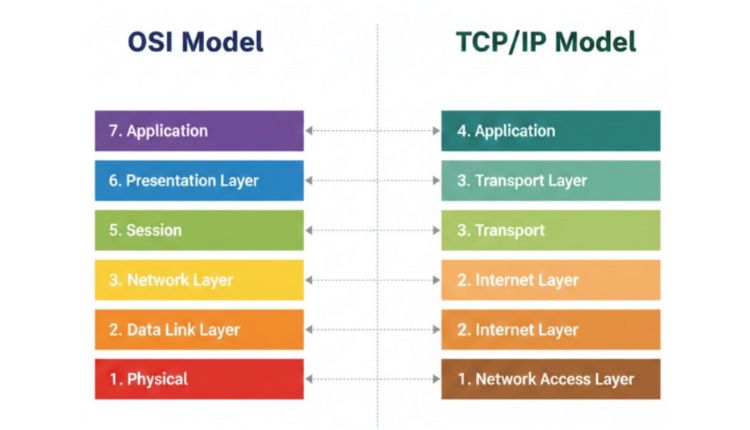
If you’ve ever sat in a high school computer science class or started an introductory tech certification, the first thing they throw at you is a colorful diagram of the OSI Model. You learn the seven layers—Physical, Data Link, Network, Transport, Session, Presentation, and Application—usually through a mnemonic like “Please Do Not Throw Sausage Pizza Away.” It’s a classic framework, and it’s great for passing a quiz. However, here is the secret most IT professionals won’t tell you: in the actual server rooms of Silicon Valley or the massive data centers of Northern Virginia, almost nobody mentions the “Session Layer” or the “Presentation Layer” in their day-to-day work.
Understanding how the internet actually functions in 2026 requires looking past the textbook. While the OSI model is a brilliant conceptual map, modern IT infrastructure relies on the TCP/IP stack, cloud-native architectures, and automated systems. Navigating these complexities can be overwhelming for students who are used to simple classroom setups, which is why many seek out expert academic help services to gain a competitive edge; finding professional academic guidance for computer networks can often be the difference between simply memorizing a diagram and actually building a functional, secure system that survives a real-world cyberattack.
The Shift from Theory to Reality: Why TCP/IP Wins
In the real world, the “theoretical” layers of the OSI model often merge into one another. The TCP/IP model, which is the actual foundation of the global internet, simplifies things into four layers: Network Access, Internet, Transport, and Application. This isn’t just a simplification for the sake of it—it reflects how software is actually written by developers. When you send a message on Discord or stream a 4K video on Netflix, your computer isn’t thinking about “Presentation” or “Session” as separate entities; it’s bundling that data directly into the Application layer.
This practical approach is what allows the internet to be so fast. By reducing the number of “stops” a packet has to make as it moves through your computer’s operating system, we reduce latency. For a high school senior looking to enter the IT field, understanding that the TCP/IP model is the “real” language of the internet is the first step toward professional expertise.
Why Software-Defined Networking (SDN) Changed Everything
Traditional networking used to be about “boxes.” You had a physical router, a physical switch, and a heavy firewall sitting in a rack. If you wanted to change how traffic flowed through a building, you had to physically go to the device, plug in a console cable, and log into its specific terminal. It was slow, manual, and prone to human error.
Today, we use Software-Defined Networking (SDN). This technology separates the “brain” (the control plane) from the “muscle” (the data plane). Imagine a smart city traffic system. In the old days, every traffic light acted on its own based on a simple timer. Now, a central computer monitors all cameras across the city and changes every light simultaneously to prevent a traffic jam before it even happens.
This level of abstraction is what allows companies like Amazon and Google to spin up thousands of virtual servers in seconds. If you are learning networking today, you aren’t just learning how to plug in cables; you are learning how to write code that manages those cables.
The Security Layer: Moving Toward Zero Trust Architecture
Another area where the traditional OSI model feels a bit dated is in how we handle security. In the 1990s and early 2000s, we built “perimeters.” This was like building a castle with a big moat and a single drawbridge. Once you were inside the castle (the office network), you were trusted.
In modern IT, especially with the rise of remote work across the US, we use a philosophy called Zero Trust. This means the network assumes everyone and everything is a threat until proven otherwise, regardless of whether you are sitting in a corporate office in New York or a coffee shop in Los Angeles. Every time you try to access a file, the system checks your identity, your device health, and your location.
For students trying to grasp these shifting paradigms, the workload can become intense. If you are struggling to configure a virtual private cloud or find yourself confused by BGP routing and encrypted tunnels, looking for specialized computer network assignment help can provide the clarity needed to master these high-level industry standards. Real-world networking is less about memorizing “Sausage Pizza” mnemonics and more about understanding how code interacts with hardware across a global, often hostile, environment.
Cloud Infrastructure: The New “Physical Layer”
In 2026, the “Physical Layer” isn’t just a CAT6 cable in your wall or a fiber optic line under the street. It’s a massive underwater cable crossing the Atlantic Ocean or a constellation of satellites like Starlink. For a modern IT professional, the “Hardware” is often someone else’s computer located three states away.
When we talk about “The Cloud” (platforms like AWS, Microsoft Azure, or Google Cloud), we are really talking about virtualization. You aren’t configuring a physical router that you can touch; you are writing a piece of code (known as Infrastructure as Code) that tells a server in a different time zone how to behave. This requires a massive shift in mindset from being a “Hardware Technician” to being a “Network Programmer.”
The Role of Automation and AI in Networking
We cannot discuss modern networking without mentioning Automation. In the past, if a network engineer wanted to update 100 routers, they had to log into each one individually. Today, they use tools like Python, Ansible, or Terraform to push an update to 1,000 routers at once with a single click.
Furthermore, Artificial Intelligence for IT Operations (AIOps) is now being used to predict network failures before they happen. AI can analyze patterns in traffic and realize that a specific router is about to overheat or that a fiber line is likely to fail, allowing engineers to fix the problem before the internet even goes down for the users.
Practical Tips for Mastery
If you are a student or a hobbyist looking to get ahead in the US tech market, here is where you should focus your energy to build a resume that stands out:
- Learn Linux Basics: Almost every piece of high-end networking gear and every cloud server runs on a version of Linux. If you know how to navigate the command line, you essentially know the “nervous system” of the internet.
- Understand APIs: Modern networks talk to each other via APIs (Application Programming Interfaces). Learning how to send a simple JSON request is just as important as knowing what an IP address is.
- Prioritize Security First: Don’t build a network and then try to “add security” later. In the professional world, we build the network inside a security framework from day one.
- Hands-on Practice: Don’t just read books. Use tools like Cisco Packet Tracer, Wireshark, or GNS3. Seeing the “packets” actually move across your screen makes the abstract concepts feel real and tangible.
Conclusion: The Map vs. The Territory
The OSI model isn’t “wrong”—it’s just a map. And as any hiker will tell you, the map is not the territory. The map helps you understand the general layout, but the territory is full of unexpected hills, rivers, and weather patterns. To succeed in the modern IT landscape, you need to understand the actual “terrain” of the cloud, the blistering speed of 5G and 6G, and the absolute necessity of automation.
By focusing on how data actually moves in the real world, rather than just how it looks on a textbook diagram, you position yourself as a true expert. You aren’t just someone who can pass a test; you are becoming an architect who can build and defend the future of the global internet.
Frequently Asked Questions:
- Why is the TCP/IP model used more than the OSI model?
While the OSI model is a great teaching tool, the TCP/IP model is the actual protocol suite the internet is built on. It is more practical for modern IT because it combines layers to match how software and hardware actually communicate.
- Is the OSI model still relevant for students in 2026?
Yes. It remains the universal language for troubleshooting. Even if we don’t use every layer daily, understanding the OSI framework helps engineers identify exactly where a network failure is happening.
- What is Software-Defined Networking (SDN)?
SDN is a modern approach that uses software applications to manage a network. By separating the network’s “brain” (control) from its “body” (forwarding), it allows for much faster and more flexible configurations than traditional hardware.
- How can I get better at computer networking assignments?
Focus on hands-on practice using simulators like Cisco Packet Tracer. For complex topics like BGP or subnetting, seeking academic guidance for computer networks can help simplify these advanced concepts and improve your practical skills.
About The Author:
Aris Williams is a Senior IT Consultant and academic mentor at MyAssignmentHelp. He specializes in cloud-native infrastructure and providing practical academic guidance for computer networks, helping the next generation of engineers master real-world systems beyond the textbook.